A leaking joint eight hundred metres underground is not a maintenance item. It is a shift you lose. Choosing a high-pressure coupling for mining pipelines comes down to matching three numbers: the working pressure of the service, the groove the pipe was actually rolled to, and the fluid the gasket will sit against for the next five years. This guide walks through the process the way our engineering team at Shandong GOLDDRILL Metal Products Co., Ltd. specifies joints for underground coal, copper and gold mines, and shows where a grooved coupling belongs in a high-pressure fluid supply system and where it plainly does not.
Define the Service Before Opening Any Catalogue
Mine piping is not one duty. Three service families cover most of the underground network, and each one punishes a joint differently.
Paste backfill and slurry lines carry gangue, tailings and cement at roughly 20 to 40 bar, with a heavy abrasive load and constant pulsation from piston pumps. High-pressure water and emulsion lines feed hydraulic support and longwall mining spray systems; on a fully mechanised face the emulsion pump station typically runs at 31.5 MPa. Dust suppression, grouting, dewatering and underground water supply sit far lower, usually under 16 bar, but across long horizontal runs with a great many joints in them.
The high-pressure coupling you need is decided by which of these three you are joining, not by the nominal pipe size on the drawing.
Set the Pressure Ceiling, and Set It Honestly
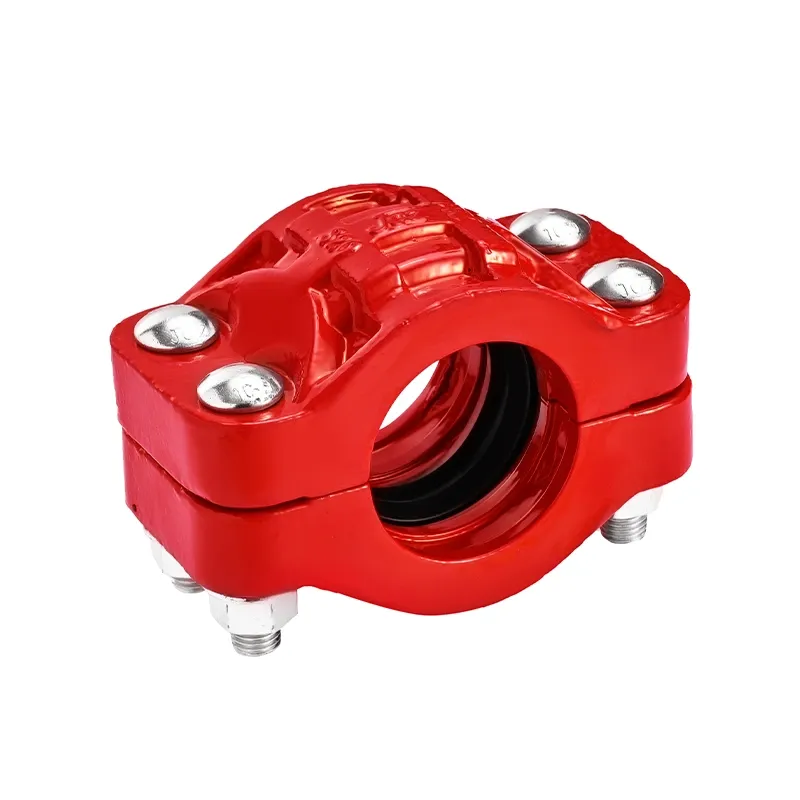
Our clamp-type and ring grooved couplings are built on a graded ladder. Low pressure clamp type is rated to 20 bar (300 psi / 2,068 kPa). Medium pressure clamp type goes to 40 bar (580 psi / 4,000 kPa). The high-pressure clamp type flexible coupling carries 63 bar (914 psi / 6,300 kPa) in DN50 to DN300, which is 2 to 12 inches. Ring flexible coupling reaches 100 bar (1,450 psi / 10,000 kPa) in DN50 to DN250. For shouldered steel pipe, the KRJ shouldered flexible coupling covers DN50 to DN350 (2 to 14 inches) at up to 42 bar (610 psi).
Treat those figures as continuous service ratings, not surge ratings. A backfill station pulses, and a high-pressure valve closing fast throws water hammer through the line. Put your margin in at design stage, not after the first burst.
Then be clear about the boundary, because it is not a material boundary. A ductile iron grooved joint is not restricted to low pressure service, and it can work on a 31.5 MPa emulsion header provided the housing, the gasket and the pipe are specified to that pressure class. What buyers get wrong is lifting a coupling out of a general duty catalogue and putting it on a header it was never rated for. The failure sits in the class, not in the iron.
Above the general duty range the system is completed with steel. Our high-pressure grooved gate valve is rated to 42 MPa (420 bar / 6,091 psi) in DN50 to DN150, in a one-piece, non-welded body of high-strength carbon or alloy steel, on emulsion and water duty, giving pipeline isolation so a section can be shut down without touching the rest of the line. Below it, the clamp-type and ring couplings carry the distribution and auxiliary circuits of the same network: dust suppression, fire water, compressed air, grouting, drainage and the branch legs of a fill line. One grooved principle across several pressure classes, on one specification sheet, is how a remote centralized emulsion supply system and a high-pressure fluid transportation line should be engineered.
Match Housing, Gasket and Coating to the Water You Actually Have
Housing. Our couplings are cast in ductile iron to ASTM A536 Grade 65-45-12, which is 65 ksi (448 MPa) minimum tensile strength with 12 percent elongation. That ductility is what lets the keyway take bolt load without the brittleness you get from grey iron castings.
Gasket. Grade T nitrile handles oil-based emulsion and general mine water. Grade E2 EPDM suits water-based service where ozone and weathering are the problem. Gasket selection follows the medium, the temperature and the pressure, and in practice it is the gasket, not the casting, that writes your leak history.
Coating and hardware. Epoxy powder coating is standard on the housing. Specify something heavier when the mine water is acidic or high in chloride, which is routine in copper and gold operations. Fasteners are zinc electroplated carbon steel, with stainless available for corrosive roadways.
Confirm the Groove, Not the Nominal Size
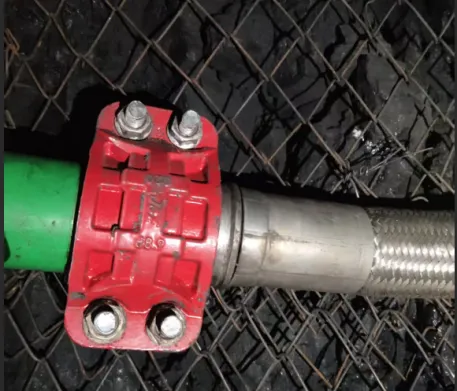
Most field complaints we receive about a high-pressure coupling are not pressure failures. They are groove mismatches. A coupling housing keyed to one roll groove gauge will not seat correctly on pipe rolled to another, and a few tenths of a millimetre of difference in groove depth, width or corner radius is enough to make the gasket roll instead of compress. Before you order, ask the supplier for the groove gauge chart and the maximum outside diameter tolerance for each size, then check both against the pipe already sitting on your site.
Choose Flexible or Rigid by Where the Joint Sits
A flexible joint allows controlled axial movement, expansion, contraction and angular deflection. That suits long horizontal runs, thermal movement, pump vibration and strata settlement in an active roadway. A rigid coupling is what you use at direction changes and at anchor points, where it carries thrust and removes the need for extra restraint. Specifying flexible everywhere is a common shortcut, and an expensive one.
What to Ask a High-Pressure Coupling Manufacturer Before Ordering
Ask for the material certificate on the housing lot, the pressure test record for the batch, and the compound datasheet for the gasket. Confirm the factory works to ISO 9001. Then check whether the same supplier can quote pipe, mining pipeline components, couplings, valves and coating against one specification sheet, because a system bought from four vendors is a system with four different failure modes. GOLDDRILL has manufactured mining pipeline products since 2008, holds ISO 9001, ISO 14001 and ISO 50001, and is recognised as a National High-Tech Enterprise and a 5G Smart Factory. Every piping system is material tested and pressure tested before it leaves the works, and custom sizes, coatings and OEM marking are standard work rather than an exception.
Three Mistakes Worth Avoiding
Sizing from a pipe outside diameter taken from a different standard than the one the pipe was manufactured to. Judging the joint by the coupling while the gasket or the adjacent mining valve is the lowest rated part of the line. And bringing a fire protection grooved coupling catalogue onto a slurry service, where abrasion, impact and the vibration of a partially empty pipe change the failure mode completely.
Conclusion
Select the coupling by service, by pressure ceiling, by groove gauge, and by gasket compatibility, in that order. Do it properly and a high-pressure mining pipeline is assembled with hand tools, pressure tested once, and then left alone for years. Get any one of those four wrong and you are changing joints in the return airway every quarter.
Send us your pipe schedule, working pressure and medium at www.golddrillcoupling.com. As a high-pressure coupling manufacturer and factory, we quote couplings, the high-pressure grooved gate valve and globe valve, fittings, coated and wear resistant pipe, and the emulsion supply system around them from a single specification.