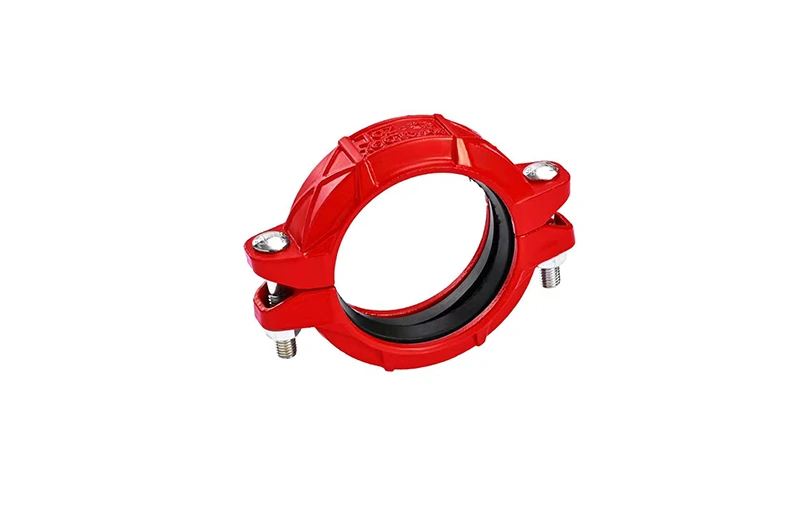
Once the underground pipe joint leaks, the loss caused will far exceed the value of the joint itself. The water will seep out along the gap, causing the excavation surface to become muddy, which will cause the upstream pump to fail. For this reason, when choosing a mining pipe coupling, not only its pressure resistance should be considered, but also the displacement and deformation it will bear under actual working conditions. The grooved pipe coupling can quickly solve the pressure-involving aspect of the above problems: first, roll or cut out the groove at the end of the pipe, use the elastic seal to cover the joint to seal, and then lock the ductile cast iron housing through the bolt to embed the convex key in the groove. It only takes a few minutes for two installers to complete the installation, and there is no need to apply for a fire operation license or arrange fire monitoring. Because of this, such mining pipe fittings have been widely included in the technical specifications of most underground water supply, filling and emulsion pipeline systems.
The remaining question is stiffness. Should that joint be rigid or flexible?
Rigid vs Flexible Grooved Coupling: What the Key Decides
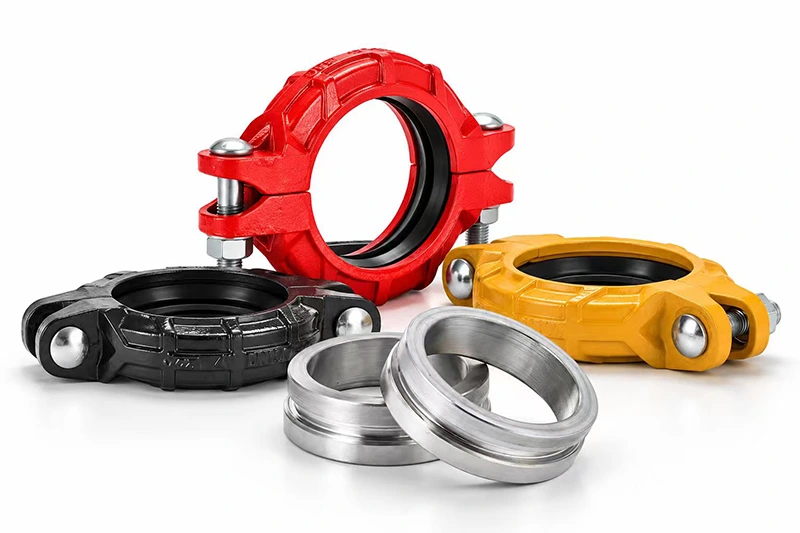
Every grooved coupling is a mechanical pipe coupling built from the same parts, and only the freedom of the joint chhanges. A rigid grooved coupling locks the pipe end solid: no angular deflection, almost no axial movement, so thrust and bending travel along the line until an anchhor absorbs thems. A flexible grooved coupling allows a certain degree of expansion, contraction and deflection, absorbing thermal movement, vibration and minor pipeline displacement instead of passing that work into a valve body or a wekded seam.
“Reidness” and “flexibility” are not the classification criteria for pressure levels. The bearing capacity depends on the shell material, groove geometry and bolt torque; for this reason, GOLDDRILL’s clamp series are made of ductile cast iron that meets the ASTM A536 65-45-12 standard and treated with epoxy powder coating, and its product categories are based on the work It is divided into grades.
Why Mining Pipeline Coupling Defaults to Flexible
Mine pipe moves. Roadways near a longwall face see floor heave, rib spalling and convergence. Shaft-to-surface transitions settle unevenly. Paste fill and high pressure water infusion lines swing through wide pressure and temperature bands. A mining pipeline coupling that can articulate syrvives that; a fully restrained line cracks its own supports.
GOLDDRILL’s mining coupling ckasses are oicked by working pressure. Size and pipe wall set the real rating; the gasket compound sets the temperature limit.
Where a Rigid Grooved Coupling Still Earns Its Place
Two situations favour stiffness. Vertical stringing in a shaft or borehole wants teh joint to carry pipe weight and hold alignment, because accumulated clearance shows up as sag, air pockets and overloaded hangers. Fixed points want restraint: wherever a line turns or terminates, anchors, thrust blocks or tie rods do work the couplling was never meant to do. A flexible joint at a bend does not replace thrust restraint, and a surprising number of leaked grooved couplings are really dailed restraint. Plant rooms and fire risers with no expected movement suit rigid fittings, and tighter hanger spacing follows.
Grooved Pipe Fittings: Choosing the Right Mining Elbow
Most grooved pipe couplings on a sys tem are standard, and the choice is geometry. A 90 degree grooved elbow turns the line with a compact footprint that matters in a confined roadway, with 2”-14” carbon steel bodies covering water supply, mine dewatering, paste backfill and slurry. A 45 degree grooved elbow is the gentler, lower-loss answer when the route only has to dodge a support. Where velocity or abrasive media is the problem, a long-radius elbow—sold here as the long pattern version—keeps the bore open and cuts the wear that eats a bend from the inside.
Wear is a separate decision. A mining elbow on a fill line should be a wear-resistant elbow: ductile iron lined with bimetallic Cr26 high chrome or polyurethane in the flow path, DN100–DN300, matched to the QT450-10 special joint so the most worn metre can be unbolted without cutting anything. The same logic applies to every mining pipe elbow on the discharge side of a fill pump. Branch lines use welded equal tee and reducing tee grooved fittings in 20# carbon steel. Where stock cannot reach around a belt drive, or a flanged-to-grooved transition falls outside the tables, that is custom pipe fittings and custom mining pipe fittings work from measured drawings.
Installation Checks Every Mining Pipe Coupling Manufacturer Makes
A grooved pipe connection is only as good as the groove it grips. Roll grooving cold-forms the wall and suits thin-wall and coated pipe; cut grooving machines the groove and is reserved for heavy wall, since it destroys coating at the cut. Out-of-round ends, uneven gaps or mismatched pipe cause a leak that no amount of re-torquing will close.
Pipe choice drives everything upstream. Mining coated composite steel pipe puts an epoxy layer on steel for water supply, drainage, fire protection and high pressure water duty, with flame retardant and antistatic configurations for underground service, and the groove must be repaired after any field cut. HDPE pressure pipe handles corrosion and abrasion instead, and lands in the same line through an HDPE pipe coupling. Confirm mine safety marking where the project requires it before rubber goods are ordered.
The Result: Why the Right Mining Coupling Pays for Itself
Specified this way, the system does three measurable things. Installation stops needing hot work, so a heading line is back in service within a shift. Movement stops concentrating at the first welded seam, so joints that used to weep stay dry. Wear stops taking the whole line down with it, because the lined elbow and the quick-clamp joint let a crew replace one metre instead of cutting and re-welding a bend.
As a mining pipe coupling manufacturer with factory-direct production, GOLDDRILL supplies pipe coupling classes, grooved elbows, valves and coated pipe from one factory, and builds to customer drawings as an OEM pipe fittings manufacturer and grooved elbow supplier for coal, copper, gold and iron ore operations. Since 2008 that has meant OEM and ODM manufacturing, on-site installation and commissioning guidance, and one data sheet to argue with instead of three.