A pipeline goes in slowly. Why? Underground you don't need to ask — one look tells you. The steel pipe is already hanging along the gate road; the crew is stuck at the joints. A 1,000 m (3,300 ft) working face, 6 m (20 ft) per length — that is at least a hundred joints. And every one of them forces a choice: flange, or coupling.
Everyone knows the flange route: weld a flange onto the pipe end, bring the two flanges together underground, run up the bolts. The grooved coupling takes a different process route. Groove both pipe ends, drop two housing halves into the grooves, tighten four bolts, and two lengths lock into one. No hot work anywhere — and every bolt you do not have to turn is a minute you do not spend under the roof.
What this article covers
• A welded flange seals in two places, so it has two independent leak paths.
• A grooved coupling seals by geometry, and its gasket tightens as pressure rises.
• The eight-step installation sequence, and why skipping any one of them shows up months later.
• The five installation mistakes we see most often — none of them a product failure.
Welded Flanges: Two Seals, Two Leak Paths
A flange joint seals in two places. One between the pipe end and the flange. One between the two flange faces, across the gasket that the bolts compress. If either one gives way, the medium inside a high-pressure line finds its way out at that joint.
A flange seals by one mechanism only: compression. The bolts squeeze the gasket until it deforms and fills the microscopic irregularities of the sealing face. That is the whole principle. The trouble is that this compression is never applied once and then valid forever:
The weld seam. The circumferential weld is the first seal. Porosity, slag inclusion, lack of penetration — any of them can leave a channel inside the seam. A hydrostatic test will find a through-wall defect; it will not find one buried inside. That kind of defect works its way into a leak after a few months of pressure pulsation.
Alignment. Two flange faces that are not parallel mean the gasket is crushed on one side and hanging free on the other. The tight side fatigues first, the loose side weeps first, and the resulting offset load ends up on the bolts.
Preload. Eight to twenty-four bolts on the same nominal bore, every one of them taken to the same torque, in a diagonal sequence, in stages. Miss one, leave one loose, and there is a gap somewhere on that sealing face.
None of these is a fitter doing poor work. They are built into the structure: a flange holds its seal by clamping force, and clamping force drifts and decays, so the seal follows it down. Under pressure, any failure here is a lateral jet at waist height in a confined space.
A coupling gasket, by contrast, is constrained inside the housing. The higher the pressure, the tighter the gasket is pressed. Its failure mode is a weep that tells you to re-torque — not a jet.
What a Grooved Coupling Is Actually Doing
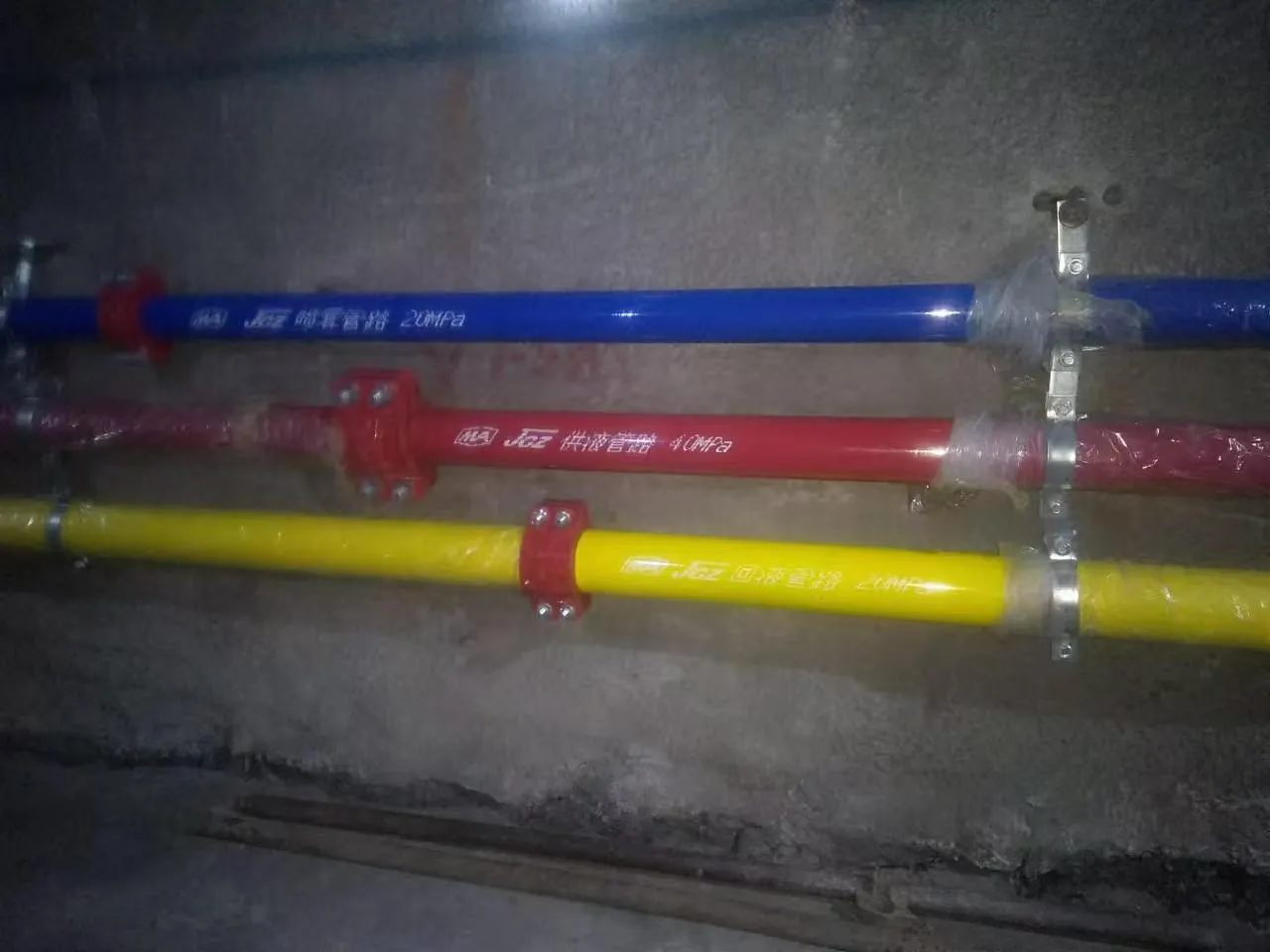
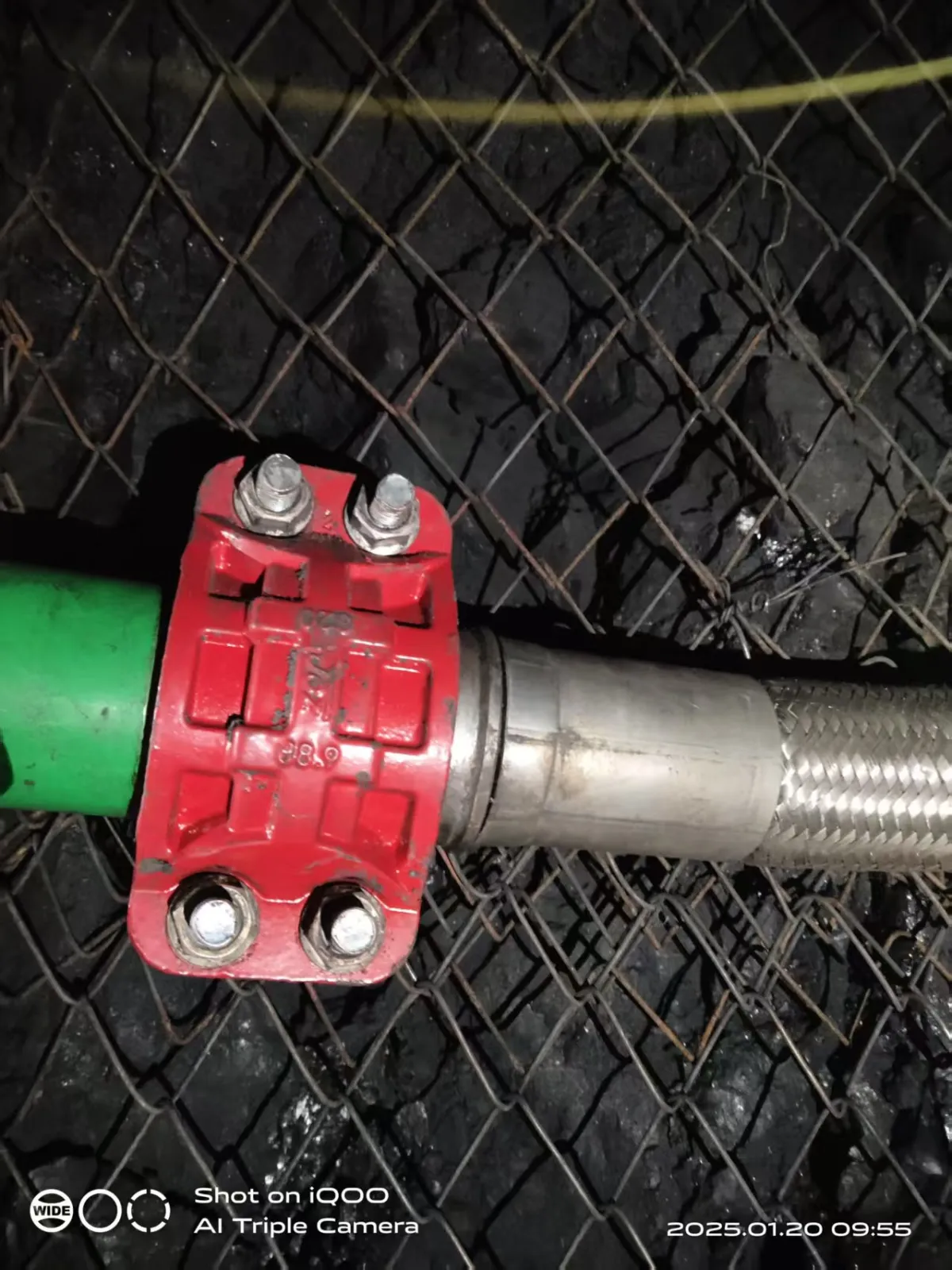
Two grooved housing halves locate by geometry, not by the fitter's eye. Each pipe end is grooved in advance; the housing grooves mate with the pipe grooves; the gasket sits on the sealing face of the pipe end; four bolts pull the two halves together.
There is no weld anywhere in the line. The housing grips the groove, so the joint cannot pull apart under pressure. The gasket is enclosed and constrained by the housing, instead of being squeezed flat between two faces the way a flange gasket is.
Underground, three things matter most in practice:
Compact. Installation needs very little space — tighten the bolts and the joint is made. One worker with one wrench can complete the whole assembly.
Safe. No heating, no welding, no open flame at any point — which is exactly why the method suits coal mines.
Fast. 20 to 30 times faster than a welded flange. No welding, and the bolts have no orientation, so working in a narrow roadway is far easier — and the physical load on mine personnel drops sharply.
The Installation Sequence That Decides Success
This sequence comes from field feedback, not from theory. Eight steps, and none of them is optional.
1. Set the supports first, then run the pipe. One support every 3 m (10 ft). Confirm the anchor points are sound before anything goes up.
2. Leave the protective caps on until the moment of assembly. A burr nicked into the gasket does not leak at installation; it leaks under pressure.
3. Clean the mating faces of the coupling. Coal slurry and debris hold the two halves apart — a joint that will not close to the specified gap is dirty eight times out of ten, not defective.
4. Lubricate evenly. A thin film of soapy water or the gasket lubricant supplied with the coupling. Skip this step and the gasket will be pinched and damaged.
5. Seat the first housing half fully — the groove must be completely engaged. The gasket sits centred on the sealing face and must not ride up on the pipe. Incomplete engagement is the single most common cause of joint failure in the field.
6. Close the second half with the numbers on the same side. The two halves are machined as a matched pair; mix them and the gap opens and the gasket loads unevenly.
7. Tighten diagonally, in stages, and watch the gap. Never take a single bolt to final torque in one pass. Bring both side gaps to within 0.5 mm and even, then torque all four to specification.
8. Check that the whole line runs true. If it does not line up, loosen and redo it.
Five Mistakes We Keep Seeing in the Field
One bolt taken to final torque first. The housing twists, and the gasket on the opposite side is crushed.
Burrs left on the pipe end. Invisible at assembly, fatal under pressure.
Mismatched halves. They are a matched set; mixing them opens the gap.
Wire used instead of a support. A few weeks of vibration will shake the joint loose.
Support spacing beyond 3 m. The line sags, and sag puts bending moment into the coupling — no coupling is designed for bending.
None of these is a product failure. All of them are installation failures, and all of them are avoidable with one torque wrench.
Frequently Asked Questions
Can two coupling halves really hold 40 MPa?
In the ultra-high-pressure range, yes — 40 MPa (5,800 psi) working pressure on the feed line, 80 MPa (11,600 psi) factory test. The condition is that the coupling, the pipe-end groove and the gasket come from one validated set.
Welding happens on surface anyway — why not just use flanges throughout?
Because the joint you actually live with every day is not the weld; it is the pair of bolted flanges underground. The flange route adds one more weld per pipe on surface, one more inspection, one more weight to transport underground — and then asks a crew to align two heavy flange faces in a restricted roadway and torque 8 to 24 bolts. At the same nominal bore, a coupling closes with four bolts, absorbs the small angular deflection real roadways impose, and can be taken down and reused when the face is finished.
How long does one joint take?
With supports already in place and pipe ends cleaned, a coupling goes together in a few minutes with hand tools. The time is not in the bolts — it is in the preparation, and in whether the route was planned before the pipe went up.
Do I need special tools?
A socket set, a ring spanner, a torque wrench, a 1 m (3 ft) breaker bar, and a can of lubricant.
Can the line be taken down and reused on the next face?
Yes — that is the design intent. Pipe, housings and fittings are recovered, inspected, re-gasketed and reinstalled in the next panel. Gaskets are consumables. Steel is not.
What support spacing do you recommend?
3 m (10 ft), with anchor points confirmed before the pipe goes up. Closer does no harm. Wider puts bending moment into the coupling — and that is the most common reason a joint weeps while the pressure test still passes.
Need a line that holds?
Shandong GoldDrill Metal Products Co., Ltd. supplies grooved couplings, high-pressure couplings and coated wear-resistant steel pipe for underground coal mines — DN25 to DN300, 6.3 MPa as standard, up to 40 MPa on emulsion feed systems. Send us your line drawing and we will come back with a joint schedule and a pressure rating for each section.