After years of on-site installation, commissioning and maintenance at coal mine roadways, filling working faces and hydraulic support sites, the picture is consistent. Static overpressure is rarely the cause of a pipeline failure. What kills underground pipework is the gap between what the spec sheet says and what the roadway does to it.
Mine operators tend to focus on the nominal pressure figure during procurement. In practice, mine fluid systems span an enormous pressure range — from 2.5 MPa dust suppression water to 40 MPa remote emulsion supply — and each pressure level has its own media, its own temperature swings, its own vibration pattern. Different pressure levels, different media and different working conditions require matched pipe, clamp, manifold and sealing solutions. Universal selection by pressure rating alone leads to leakage, vibration, water hammer damage and, eventually, system shutdown.
A complete underground fluid system is made up of pump stations, distribution shunt manifolds, steel pipe, special fittings and quick coupling clamps. Every component is a link in the pressure-bearing and vibration-resisting chain. In our on-site records, the great majority of underground pipeline faults occur at joints and at sealing parts — the most overlooked, but also the most critical, parts of any system selection.
Field-Based Selection by Pressure Tier
Based on long-term downhole service, we organise our recommendations into three pressure tiers. The boundaries are not arbitrary; they line up with how the systems are actually built in Chinese coal mines.
Tier 1 — 2.5 to 4.0 MPa: Conventional Water Supply and Dust Suppression
This is the most widely used basic pipeline system underground — daily dust reduction, fire water, roadway flushing water, grouting water supply. It is also where cost-cutting mistakes are most common.
A lot of customers choose ordinary carbon steel pipe to save money. Our on-site inspection of those installations shows the same pattern: mine water is often acidic, saline and mixed with fine coal fines; the roadway stays humid year-round; permanent vibration is present. Under these conditions, uncoated carbon steel pipe shows internal wall corrosion and coating peeling within one to two years, and leakage follows.
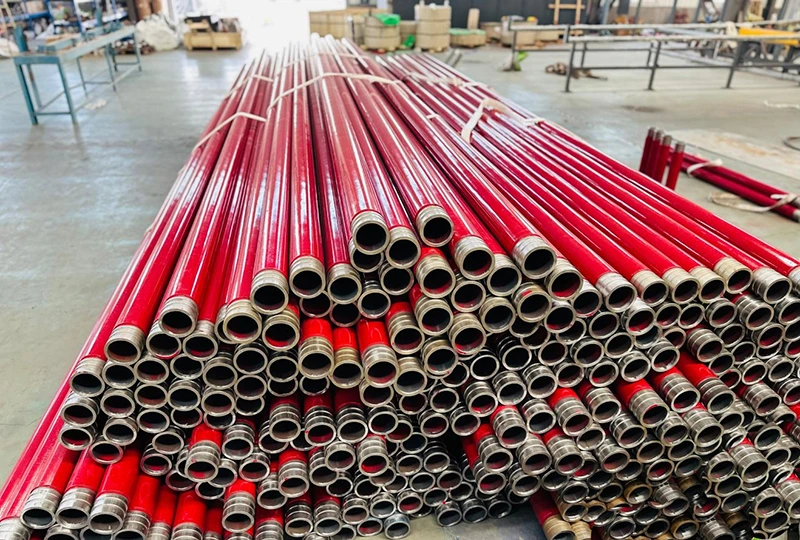
GoldDrill field recommendation: Use internally and externally anti-corrosion coated steel pipe with our 4.0 MPa high-strength quick coupling clamps. In roadways with frequent equipment movement and noticeable strata movement, push the rating up to 6.3 MPa to keep a safety margin against pressure pulsation and accidental water hammer. Standard size range DN25–DN300 covers the usual mine water supply layout.
Tier 2 — 6.3 MPa: High-Pressure Water Injection and Filling Slurry
High-pressure water injection and goaf filling slurry transport put noticeably higher demands on both pressure resistance and wear resistance. The instantaneous water hammer pressure in these systems can reach 1.5 to 2 times the working pressure during valve switching and pump start-stop. A 4 MPa component in a 6.3 MPa system is exposed to dynamic loads it was never designed for, and the failure mode is almost always at the joint.
GoldDrill field recommendation: Standardise on 6.3 MPa forged steel fittings, thickened wear-resistant pipe and dedicated anti-abrasion sealing assemblies. For elbows and tees where slurry wear is concentrated, apply localised thickening and a wear-resistant coating — do not over-spec the entire run, because the wear is not uniform. Pair the line with our distribution manifolds to split the high-pressure slurry cleanly into multiple working circuits without choking flow.
Tier 3 — 31.5 to 40 MPa: Remote Emulsion Supply for Hydraulic Supports
This is the highest pressure service in any underground mine. The medium is emulsion, not water. The pressure is 31.5 MPa at the standard rating, with peaks towards 40 MPa depending on the face layout. The fatigue, sealing and impact loads on every component are not comparable to anything in Tier 1 or Tier 2. Ordinary medium-pressure carbon steel products do not survive long-term high-frequency pressure pulsation in this service; seals age fast, clamps loosen, and pipeline fatigue cracking shows up within a working quarter.
GoldDrill field recommendation: This is where the Emulsion Remote Supply System line comes in. Components in this line are custom-engineered for ultra-high pressure service — alloy forged steel bodies, special elastomer sealing materials, factory burst pressure testing well above the rated standard, and matched hydraulic accumulators at the pump discharge to damp pulsation. Every component ships with its full pressure test report. The standard pipeline series (DN25–DN300, 6.3 MPa) is not used in this tier; the two lines do not interchange.
Field Pain Points We See Over and Over
Most underground pipeline failures are not quality problems. They are selection and installation problems that we have seen repeatedly across sites:
1. Pressure pulsation damage. Piston pumps send continuous pressure waves down the line. Over months of operation, ordinary clamps loosen and ordinary seals age. In ultra-high pressure systems, a matched pulsation-damping accumulator at the pump discharge is not optional.
2. Water hammer impact. Rapid valve closure on long-distance pipelines causes an instantaneous pressure surge. Slow-closing valves and pressure-rated fittings are the only real defence against a 3 a.m. burst joint.
3. Incorrect installation torque. Too loose and the joint weeps. Too tight and the sealing groove is deformed, which fails later without warning. Torque wrenches are cheap; the joint is not.
4. Strata movement. Underground roadway displacement is a given, not an exception. Pipeline joints need a torque re-check and a secondary fasten after every significant rock stratum event, before the line is re-pressurised.
Why GoldDrill Is Set Up for This Work
A trading company can hand you a catalogue. We are the factory that machines the parts in it.
5. Two matched product families. Standard pipeline series for water, dust suppression, grouting and most backfill service (up to 6.3 MPa, DN25–DN300), and a dedicated Emulsion Remote Supply System line for 31.5 to 40 MPa hydraulic support service. Customers get the right answer for their pressure tier, not a generic compromise.
6. Full certification. ISO 9001 quality system certification and China MA / KA mine safety certification across the relevant product families. Every batch ships with a complete factory pressure test report.
7. Customisation for non-standard conditions. High corrosion, high wear, special geometry, non-standard lengths or fittings — we manufacture against drawings rather than catalogue numbers, because that is what the factory exists to do.
8. Field-derived engineering. Our product specs are written from on-site conditions, not from a textbook. Vibration, corrosion and strata movement are inputs, not afterthoughts.
Get in Touch
Underground high-pressure fluid systems are the blood vessels of a mining operation. Selection matched to the actual pressure tier and working condition is what keeps the system running safely for years, not months.
If you have a mine pipeline layout, a product selection question, or a custom specification to discuss, send the working conditions and our engineering team will come back with a tier-correct proposal and a quote. We work with long-term mine customers and with project-based procurement teams on the same terms. Contact Shandong GoldDrill Metal Products Co., Ltd. to start a conversation.